yiwu-jiehui-lighting-electrical-appliance-co-ltd-en
LED Bulbs
LED Bulbs
| Marking power | Voltage V | Drive scheme | Actual power W | Lamp bead model | Lamp bead model | Color temperature K | Color temperature K | CRI | Lamp size MM |
| 6W | 220 | Linear | 4.95 ±10% | 2835 6V/1W | 6 | 6500K/3000K | 450 | ≥80 | 50*100 |
| 9W | 220 | Linear | 8.54 ±10% | 2835 6V/1W | 10 | 6500K/3000K | 800 | ≥80 | 60*114 |
| 13W | 220 | DOB | 11.34 ±10% | 2835 6V/1W | 14 | 6500K/3000K | 1100 | ≥80 | 70*126 |
| 18W | 220 | DOB | 15.42 ±10% | 2835 6V/1W | 20 | 6500K/3000K | 1600 | ≥80 | 80*146 |
| 28W | 220 | DOB | 25.88 ±10% | 2835 6V/1W | 32 | 6500K/3000K | 2700 | ≥80 | 99*184 |
| 38W | 220 | DOB | 36.89 ±10% | 2835 6V/1W | 42 | 6500K/3000K | 3500 | ≥80 | 114*213 |
| 48W | 220 | DOB | 45.57 ±10% | 2835 6V/1W | 52 | 6500K/3000K | 4700 | ≥80 | 123*227 |
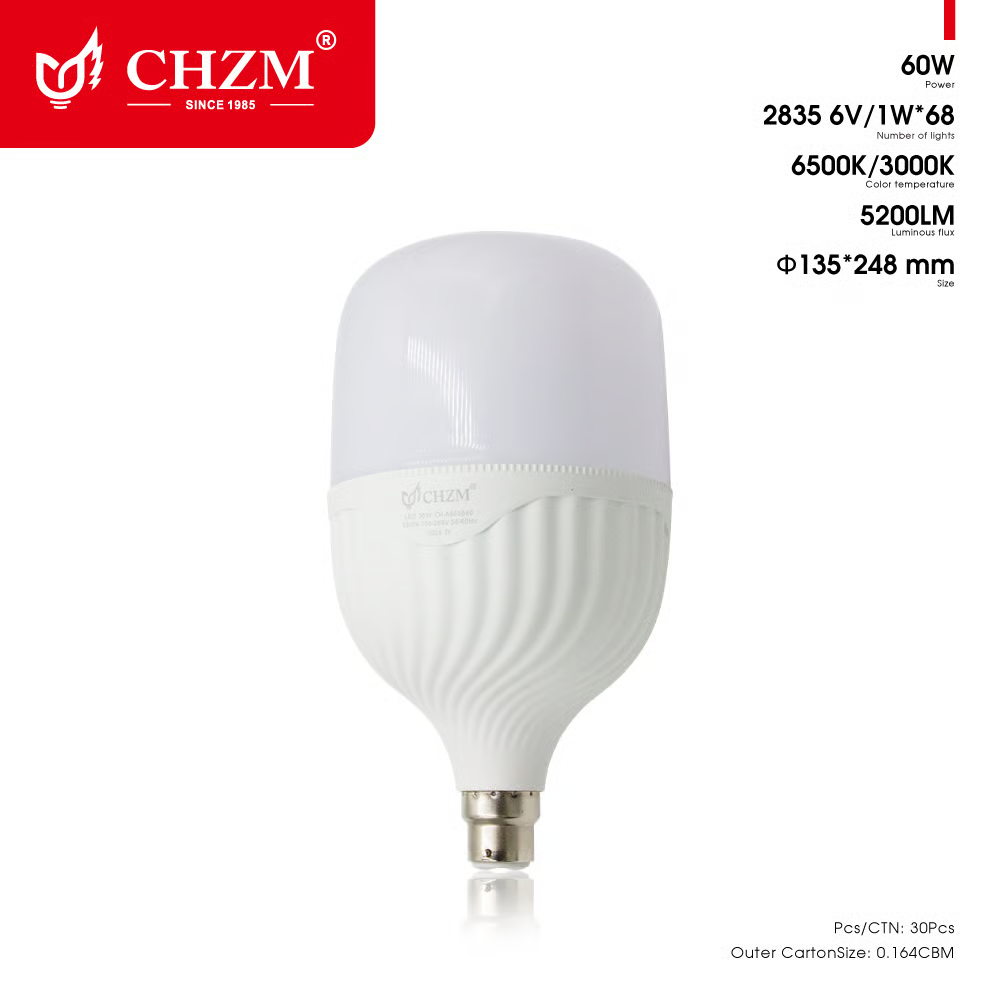
| 60W | 170¡«265 | DOB | 55 ±10% | 2835 6V/1W | 68 | 6500K/3000K | 5200 | ≥80 | 135*248 |
LED Bulb
1. LED Chip
This is the core component of the LED bulb. It uses 2835 6V/1W high-quality chips to provide brighter, more stable and more accurate color light.
Depending on the application scenario, the chip can produce different colors of light, including pure colors such as cool white light and warm white light.
2. Encapsulation Material
Some encapsulation materials also add phosphors to convert the blue light or ultraviolet light emitted by the chip into other colors of light to achieve the desired color temperature or color mixing effect.
3. Heat Sink
Since the LED chip generates heat during operation, if the heat is not dissipated in time, the chip temperature will be too high, thereby reducing the luminous efficiency, shortening the service life and even damaging the chip. The heat sink is usually made of metal materials (such as aluminum), and its design shape (such as fin type) and size are determined according to the power and heat dissipation requirements of the bulb.
4. Driver
The function of the driver power supply is to convert the input AC power into DC power suitable for the LED chip to work, and stabilize the current and voltage to ensure that the LED bulb emits light normally. A high-quality driver can provide stable power output, adapt to different grid voltage fluctuations, and have high conversion efficiency to reduce energy loss.
5. Energy saving and high efficiency
- LED bulbs have high luminous efficiency, usually measured in lumens per watt (11lm/W). Compared with traditional incandescent bulbs and fluorescent bulbs, LED bulbs consume less electricity at the same brightness. For example, the luminous efficiency of ordinary incandescent bulbs is about 10-15 lm/W, while the luminous efficiency of LED bulbs can reach more than 100-150 lm/W, which means that LED bulbs can save a lot of energy while providing the same brightness.
6. Long life
- Under normal use conditions, the life of LED bulbs can reach 25,000-50,000 hours, or even longer. This is mainly because LED bulbs do not have easily damaged parts such as filaments, and their luminous principle determines that under proper heat dissipation conditions, the performance of the chip can remain stable for a long time. In comparison, the lifespan of an incandescent bulb is usually only 1,000 to 2,000 hours, and the lifespan of a fluorescent bulb is about 10,000 to 15,000 hours.
7. High Color Rendering Index (CRI)
The color rendering index (CRI) is a measure of the ability of a light source to reproduce the color of an object, ranging from 0 to 100. LED bulbs can achieve a higher color rendering index, and generally high-quality LED bulbs have a CRI of more than 80.